23 Indoor Walking Workouts You’ll Love to Try Today
INTRODUCTION
You do not need a gym, fancy equipment, or hours of free time to get moving. Your own home can give you plenty of ways to make walking more active and enjoyable.
These indoor walking workouts bring together simple routines you can use in a living room, hallway, bedroom, kitchen, or even on a staircase. They are designed for beginners and busy adults who want practical movement options without complicated choreography or expensive equipment.
You’ll find ideas for changing your pace, adding gentle knee lifts, using music, creating simple walking patterns, and making better use of the space around you. Some routines take only a few minutes, while others can be combined for a longer session.
I’ve noticed that having several easy options makes it much easier to stay consistent. Save these ideas so you always have a fresh routine ready when the weather, schedule, or motivation keeps you indoors.
March In Place
Image Description: Bright home workout room with warm natural window light, soft beige walls, light wood flooring, teal and coral fitness accents, comfortable sneakers, small wall mirror, and open walking space. Front three-quarter camera angle, crisp realistic photography, clean Pinterest aesthetic, energetic yet welcoming atmosphere.
The simplest moves can keep your whole body engaged when you add purpose to each step. March in place with your feet landing softly, knees lifting comfortably, and arms swinging naturally. Start slowly for one minute, then build toward a brisk rhythm as your body warms up.
I’ve noticed that marching becomes much more useful when you focus on posture rather than speed. Keep your chest lifted, shoulders relaxed, and gaze forward. Count each minute as a small movement win. This approach works especially well when you have limited floor space or want an easy starting point.
Hallway Pace Walk
Image Description: Narrow modern hallway with pale oak flooring, cream walls, soft daylight from a nearby window, simple framed artwork, and a woman wearing a coral athletic top with navy leggings walking briskly. Side perspective, realistic photography, gentle shadows, uncluttered Pinterest fitness aesthetic.
A hallway can become your personal walking lane with almost no setup. Walk from one end to the other at a steady pace, turn carefully, and continue for several minutes. Keep your steps controlled near walls, furniture, rugs, and doorways so your route stays clear.
- Clear shoes, toys, cords, and small furniture from the walking path.
- Walk tall instead of leaning forward.
- Swing your arms naturally to increase rhythm.
- Turn with smaller steps rather than pivoting sharply.
- Begin with five minutes if you are new to regular exercise.
Indoor walking workouts become easier to maintain when they fit naturally into your home. A hallway route also gives you a visible endpoint, which can make short sessions feel more structured. I’ve found that alternating brisk laps with slower recovery laps helps prevent boredom while keeping the routine manageable for beginners.
Music Step Intervals
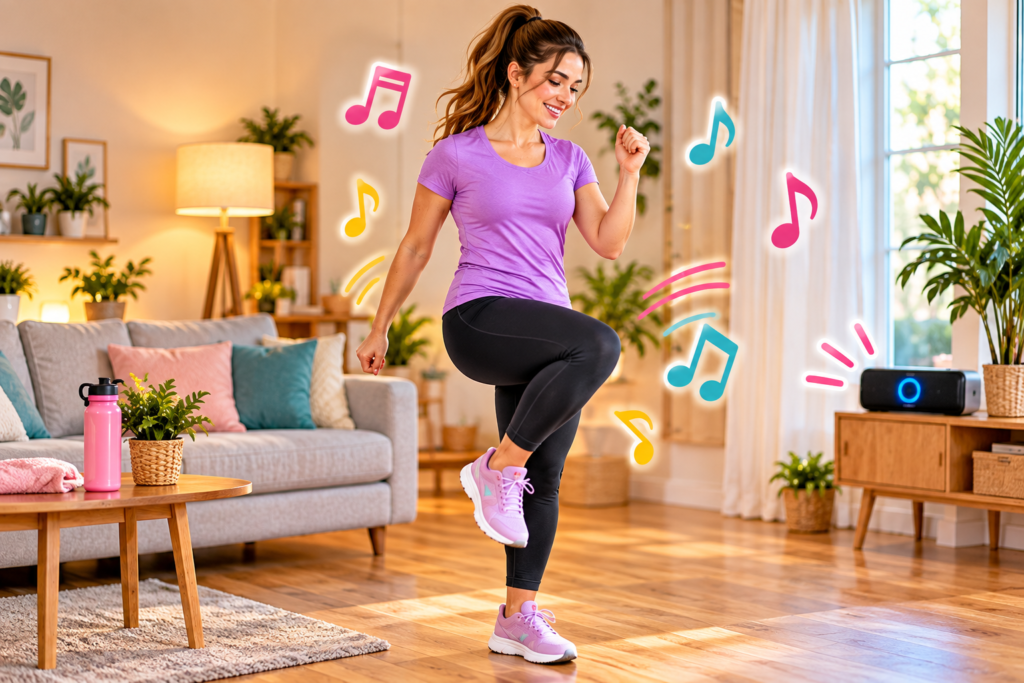
Image Description: Cozy living room with warm lamp glow and subtle daylight, honey-colored wood floor, soft gray sofa, small speaker, water bottle, and woman in a lavender workout shirt with black leggings stepping rhythmically. Slight overhead camera angle, realistic lifestyle photography, inviting Pinterest fitness aesthetic.
Music can turn an ordinary walking session into a lively interval routine. Choose several upbeat songs and match your pace to the rhythm. Walk gently during slower sections, then increase your steps during faster parts without forcing your speed beyond a comfortable level.
Quick Tip: Pick three songs with different tempos instead of playing one playlist on repeat. Use the slowest song as your warm-up, the fastest for brisk intervals, and the final song for an easy cooldown.
Changing pace gives your session more variety without requiring complicated exercises. Keep your faster sections short at first, such as 30 to 60 seconds, followed by an easier pace. In my experience, music-based intervals can make a short home workout feel more purposeful because each song provides a natural marker for changing intensity.
Knee Lift Walk
Image Description: Bright minimalist home studio with pale wood flooring, warm natural sunlight, cream walls, small indoor plant, water bottle, and woman wearing a turquoise athletic top with plum leggings performing controlled knee lifts. Front-facing camera angle, realistic fitness photography, soft shadows, clean Pinterest aesthetic.
BEFORE: A regular walking pace can feel repetitive when your feet follow the same movement for several minutes. Your arms may stay relaxed at your sides, and your knees may barely lift.
AFTER: Raise each knee slightly higher while maintaining a steady rhythm. Keep your core gently engaged and land softly before lifting the opposite leg.
A knee lift variation adds more movement to an ordinary walking session without requiring extra equipment. Keep the height comfortable rather than trying to lift your knees as high as possible. I’ve noticed that controlled movement feels more sustainable than rushing, especially during longer home sessions. Start with 30 seconds, then recover at an easy pace.
Step Touch Rhythm
Image Description: Airy living room with soft daylight, light oak floor, cream sofa, muted peach and sage accents, and woman in a yellow athletic shirt with teal leggings performing side step touches. Eye-level camera angle, realistic lifestyle photography, gentle shadows, spacious uncluttered Pinterest workout aesthetic.
- Step right: Move your right foot sideways and bring your left foot toward it.
- Step left: Reverse the movement, keeping your knees slightly bent.
- Add arms: Swing your arms naturally from side to side as your feet move.
- Build rhythm: Continue for 30 to 60 seconds, then slow down for recovery.
Side-to-side movement breaks up forward walking while keeping the routine simple. Keep your steps small enough that you remain balanced and have plenty of space around you. This variation works nicely between faster walking intervals, giving your legs a different movement pattern without turning the session into a complicated dance routine.
Treadmill Incline Walk
Image Description: Modern home gym with compact treadmill, warm natural window light, light wood flooring, white walls, small green plant, and woman wearing a coral workout top with charcoal leggings walking at a gentle incline. Three-quarter side camera angle, realistic photography, clean premium Pinterest fitness aesthetic.
| Feature | Flat Walking | Incline Walking |
|---|---|---|
| Effort | Lower | Higher |
| Pace | Comfortable to brisk | Usually slower |
| Main Focus | Steady walking | Increased challenge |
| Setup | Treadmill or open floor | Incline-capable treadmill |
A small incline can make treadmill walking feel noticeably more demanding without requiring a faster pace. Begin with a modest setting and maintain an upright posture rather than leaning heavily onto the handles. For beginners, a short incline interval followed by flat walking provides an easy way to adjust effort gradually.
Box Step Pattern
Image Description: Bright open living room with warm morning sunlight, pale wood flooring, cream walls, soft blue accents, and a woman wearing a green athletic top with peach leggings stepping around four small floor markers arranged in a square. Slight overhead perspective, realistic photography, clean Pinterest fitness aesthetic.
DO:
- Mark four safe corners with small floor objects.
- Step forward, sideways, back, and sideways around the pattern.
- Keep your steps controlled and your chest upright.
- Switch directions after each round.
DON’T:
- Don’t use slippery objects as markers.
- Don’t make the square so large that you lose balance.
- Don’t rush the turns.
- Don’t step backward without checking your space first.
A simple box pattern gives your feet a clear route to follow, which can make indoor movement feel less repetitive. Keep the pattern compact and practice slowly before increasing your pace. I’ve seen this approach work well for people who enjoy structure because each completed loop gives them an easy progress marker.
Chair Loop Walk
Image Description: Sunlit dining area with warm natural light, light oak floor, round wooden table, sturdy dining chairs, cream walls, and woman in a lavender top with blue leggings walking carefully around the furniture. Side camera perspective, realistic home fitness photography, soft neutral palette.
Cost: Low | Time: 5 to 15 minutes
Skill Level: Beginner | Best For: Small spaces
Equipment: Sturdy chair | Difficulty: Easy to moderate
A sturdy chair can provide a useful reference point for a compact walking route, especially in a smaller room. Keep enough clearance around the chair to walk comfortably without bumping into it. In my experience, a familiar household setup can make short movement breaks easier to start because everything is already nearby.
Fast Feet Intervals
Image Description: Modern home workout space with soft daylight, warm beige flooring, neutral walls, small digital timer, water bottle, and woman wearing a bright pink athletic top with navy leggings performing quick low-impact foot steps. Dynamic side camera angle, realistic photography, subtle motion feel, crisp Pinterest fitness style.
Fast feet do not need to mean jumping or sprinting. Stand tall and take quick, light steps in place while keeping both feet close to the floor. Begin with 15 seconds of faster movement, then walk slowly for 45 seconds. Repeat several rounds based on your comfort level.
Keep your arms moving naturally to help maintain rhythm, but avoid tightening your shoulders. A short interval is enough to change the pace of your session. If your steps become heavy or your form feels unstable, slow down immediately. The goal is controlled movement, not maximum speed.
Side Shuffle Steps
Image Description: Spacious modern living room with pale wood flooring, warm natural sunlight, cream walls, soft terracotta accents, and a woman in a sky-blue athletic top with coral leggings performing controlled side shuffle steps. Eye-level three-quarter camera angle, realistic fitness photography, clean Pinterest aesthetic.
DO:
- Keep your knees slightly bent as you move sideways.
- Take two or three small steps in one direction.
- Keep your chest lifted and eyes forward.
- Reverse direction smoothly after reaching your marker.
DON’T:
- Don’t cross your feet while moving quickly.
- Don’t shuffle near slippery rugs or furniture.
- Don’t make the steps wider than your balance allows.
- Don’t sacrifice control just to increase speed.
Side shuffles add lateral movement to a routine that usually travels forward or stays in place. Keep the motion low and controlled, especially if you’re new to this pattern. A few short rounds can add variety between regular walking intervals while keeping the workout easy to perform in a living room or open hallway.
Stair Step Bursts
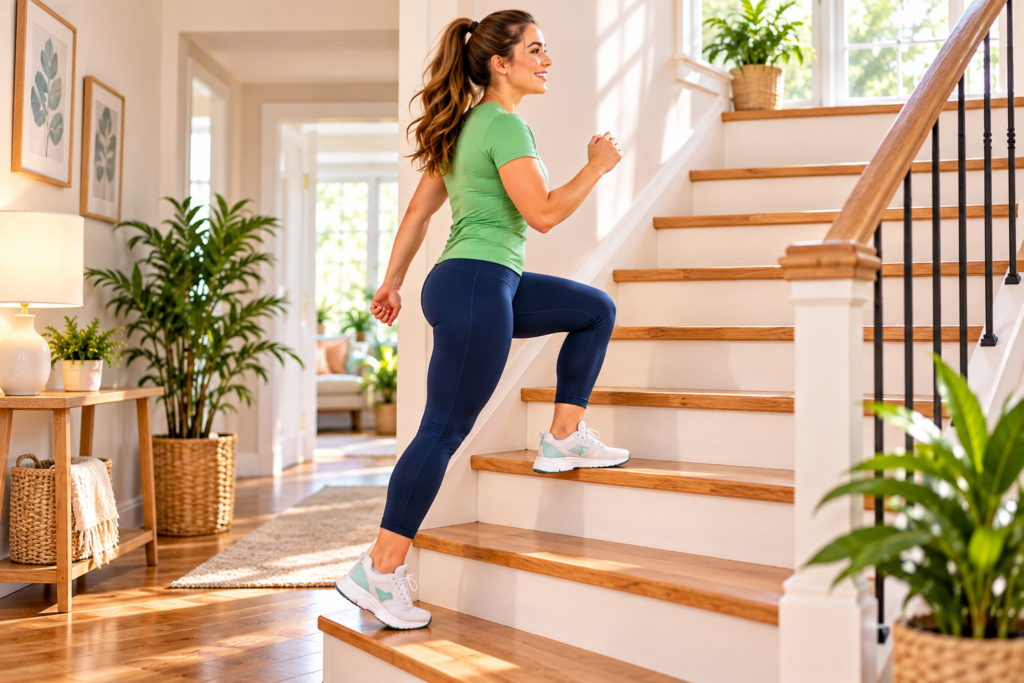
Image Description: Bright home staircase with natural window light, warm wooden steps, cream walls, simple railing, and woman wearing a green athletic shirt with navy leggings stepping upward carefully. Side-angle camera perspective, realistic lifestyle photography, soft shadows, uncluttered Pinterest fitness aesthetic.
Cost: Free if stairs are available | Time: 5 to 10 minutes
Skill Level: Beginner to intermediate | Best For: Short bursts
Equipment: Staircase and sturdy railing | Difficulty: Moderate
Stairs can add a natural change in intensity to your walking routine. Start with slow, deliberate steps and use the railing for balance when needed. Walk on a flat surface between stair bursts to recover. Keep the number of repetitions comfortable rather than treating every round as a race.
Living Room Laps
Image Description: Cozy spacious living room with large windows, soft afternoon daylight, light oak flooring, cream sofa, woven rug placed away from the walking path, indoor plants, and woman wearing a peach top with sage leggings walking briskly. Wide-angle camera view, realistic Pinterest lifestyle photography.
A few laps around your living room can turn unused floor space into a simple walking route. Clear the main path first, then choose a direction and keep your pace steady. Change direction occasionally to avoid repetitive turning patterns and keep your movement comfortable.
I’ve noticed that counting laps can make short sessions easier to track without needing a fitness device. Set a simple target, such as five minutes or ten laps, and adjust it as needed. This approach suits busy days when you want movement without changing clothes, traveling anywhere, or setting up complicated equipment.
Tempo Change Walk
Image Description: Bright contemporary living room with soft morning sunlight, pale wood flooring, cream walls, muted blue sofa, small plant, and woman wearing a coral workout top with teal leggings walking briskly through an open space. Side perspective, realistic lifestyle photography, gentle shadows, polished Pinterest fitness aesthetic.
- Start with two minutes at an easy pace.
- Increase to a brisk pace for 30 to 60 seconds.
- Return to an easier pace for recovery.
- Repeat the pattern several times.
- Finish with two slower minutes.
Changing your pace gives a basic home walking session a clear rhythm. The faster sections should feel noticeably more active without leaving you breathless or unsteady. Keep your recovery periods long enough to regain comfortable breathing. This simple pattern works well for beginners who want variety without learning complicated movements.
Arm Swing Walk
Image Description: Sunlit minimalist home studio with warm white walls, honey-toned flooring, soft green plant, water bottle, and woman wearing a lavender athletic shirt with coral leggings walking while swinging her arms naturally. Front three-quarter camera angle, realistic photography, soft glow, clean Pinterest wellness aesthetic.
Quick Tip: Keep your arms bent comfortably and swing them naturally from the shoulders. Avoid forcing a large range of motion or tightening your hands. Let your arm movement match your walking rhythm rather than trying to move as quickly as possible.
An intentional arm swing can make indoor walking feel more coordinated and active. Keep your shoulders relaxed and avoid lifting them toward your ears. I’ve noticed that focusing on smooth arm movement also helps people pay closer attention to posture, which can make a familiar routine feel more purposeful without adding equipment.
Figure Eight Walk
Image Description: Spacious bright home workout room with light oak flooring, warm natural window light, cream walls, two small colorful floor markers creating a figure eight path, and woman in a yellow athletic top with blue leggings walking around them. Slight overhead perspective, realistic Pinterest fitness photography.
BEFORE: Walking back and forth in a straight line can become predictable, especially during longer indoor sessions. Repeated sharp turns may also feel awkward when the route is tight.
AFTER: Place two safe markers several feet apart and walk a gentle figure eight around them. Keep each curve wide, slow your pace during turns, and return to a steady rhythm through the center.
A figure eight creates changing directions while keeping the movement continuous. Use lightweight markers that cannot slide under your feet, and leave plenty of open space around the route. This pattern works particularly well for people who lose interest during repetitive laps because every turn slightly changes the walking path.
Low Impact March
Image Description: Bright minimalist bedroom workout space with soft morning sunlight, pale wood flooring, cream walls, neatly made bed, small green plant, and woman wearing a mint athletic top with peach leggings performing gentle marching steps. Front camera angle, realistic lifestyle photography, soft shadows, calm Pinterest fitness aesthetic.
- Set your stance: Stand tall with feet about hip-width apart and relax your shoulders.
- Lift gently: Raise one foot a few inches while keeping the opposite foot stable.
- Alternate sides: Lower the foot softly and repeat on the other side.
- Add rhythm: Swing your arms naturally and continue for 30 to 90 seconds.
- Recover: Slow the movement whenever your breathing becomes uncomfortable.
Low-impact marching keeps both feet close to the floor, making it useful for gentle movement days. Focus on smooth transitions instead of lifting your knees high. If balance feels uncertain, stay near a sturdy surface without leaning on it. Short rounds can fit easily into a morning routine, work break, or evening reset.
Towel Line Walk
Image Description: Clean home workout area with warm natural daylight, light wooden floor, cream walls, rolled white towel laid straight across the floor as a visual walking line, water bottle, and woman wearing a turquoise top with lavender leggings. Overhead three-quarter camera view, realistic Pinterest fitness photography.
| Option A | Option B |
|---|---|
| Walk beside the line | Walk along the line |
| Wider balance margin | More precise foot placement |
| Easier for beginners | More coordination required |
| Slower pace | Moderate controlled pace |
A towel can act as a simple visual guide without requiring workout equipment. Keep it completely flat so it cannot bunch beneath your feet. Walk beside it if you prefer extra space, or follow the line with careful foot placement. The goal is controlled stepping, not perfect precision or speed.
Walk And Reach
Image Description: Airy home fitness room with large windows, soft natural light, light oak floor, cream walls, small indoor plant, and woman wearing a coral athletic top with sage leggings walking while reaching her arms overhead. Front three-quarter camera angle, realistic photography, warm Pinterest wellness aesthetic.
Walking becomes more engaging when your upper body joins the movement. Take several comfortable steps while reaching both arms forward, then return your arms to a relaxed swing. Repeat with gentle overhead reaches if your shoulders allow. Keep your ribs relaxed and avoid arching your lower back as your arms rise.
Start with 20 to 30 seconds of reaching, followed by ordinary walking. That small change gives your shoulders and arms something new to do while your feet keep moving. I’ve noticed that alternating simple movements like this helps break up longer sessions without making the routine feel like a separate strength workout.
Kitchen Counter Walk
Image Description: Bright modern kitchen with warm natural window light, light oak flooring, cream cabinets, pale stone counters, a clear open walkway, and woman wearing a teal athletic top with coral leggings walking briskly. Three-quarter side camera angle, realistic lifestyle photography, soft shadows, clean Pinterest fitness aesthetic.
Cost: Free | Time: 5 to 15 minutes
Skill Level: Beginner | Best For: Short movement breaks
Works In: Clear kitchen area | Difficulty: Easy
A kitchen can provide a convenient route for short walking sessions when the floor is clear. Keep away from hot appliances, wet areas, sharp corners, and loose mats. Walk around the safest open section at a comfortable pace, especially during quick movement breaks between daily tasks.
Toe Tap Walk
Image Description: Minimalist living room with warm afternoon sunlight, pale wooden flooring, cream walls, small wooden stool, water bottle, and woman wearing a pink athletic top with navy leggings performing alternating toe taps. Front three-quarter camera angle, realistic photography, soft natural shadows, fresh Pinterest workout aesthetic.
Toe taps add a simple coordination challenge without requiring large movements. Step forward lightly with one foot, tap your toes, return to the starting position, and switch sides. Keep your supporting leg slightly bent and maintain a steady rhythm. After several repetitions, transition into ordinary walking for an easy recovery.
I’ve noticed that alternating toe taps work nicely when a full walking route is unavailable. They give your feet a clear movement pattern while keeping the exercise compact. Start slowly enough to stay balanced, then gradually increase the rhythm. A countertop can be nearby for reassurance, but avoid leaning heavily on it.
Countdown Walking Circuit
Image Description: Cozy home workout corner with warm lamp lighting, soft beige walls, light wood flooring, digital timer, water bottle, and woman wearing a mustard athletic top with teal leggings walking briskly. Wide three-quarter camera angle, realistic lifestyle photography, subtle warm glow, organized Pinterest fitness aesthetic.
- 2 minutes: Walk at an easy pace to warm up.
- 1 minute: Increase to a brisk pace.
- 30 seconds: March with slightly higher knees.
- 1 minute: Return to comfortable walking.
- 30 seconds: Add relaxed arm swings.
- 2 minutes: Finish with an easy cooldown.
A countdown circuit removes the guesswork from a short home session. Keep the faster portions controlled and adjust the timing if you are new to exercise. The variety gives you several movement changes without requiring complicated choreography. It also makes a useful template for days when you have only a few minutes available.
Window Walk Break
Image Description: Peaceful home interior beside a large sunny window, warm natural daylight, light oak flooring, cream curtains, soft beige furniture, small green plant, and woman wearing a sky-blue athletic top with peach leggings walking gently. Side camera perspective, realistic lifestyle photography, airy Pinterest wellness aesthetic.
Quick Tip: Use a natural pause in your day as your movement cue. Walk near a safe open window area for five minutes, keeping the route clear and your pace comfortable. If sunlight is strong, use sheer curtains or move slightly away from direct glare.
Short walking breaks can help interrupt long periods of sitting without requiring a full workout session. Keep your goal simple: stand up, move continuously, and return to your task afterward. I’ve noticed that attaching movement to an existing routine, such as a morning drink or afternoon break, makes consistency easier.
Pillow Step Route
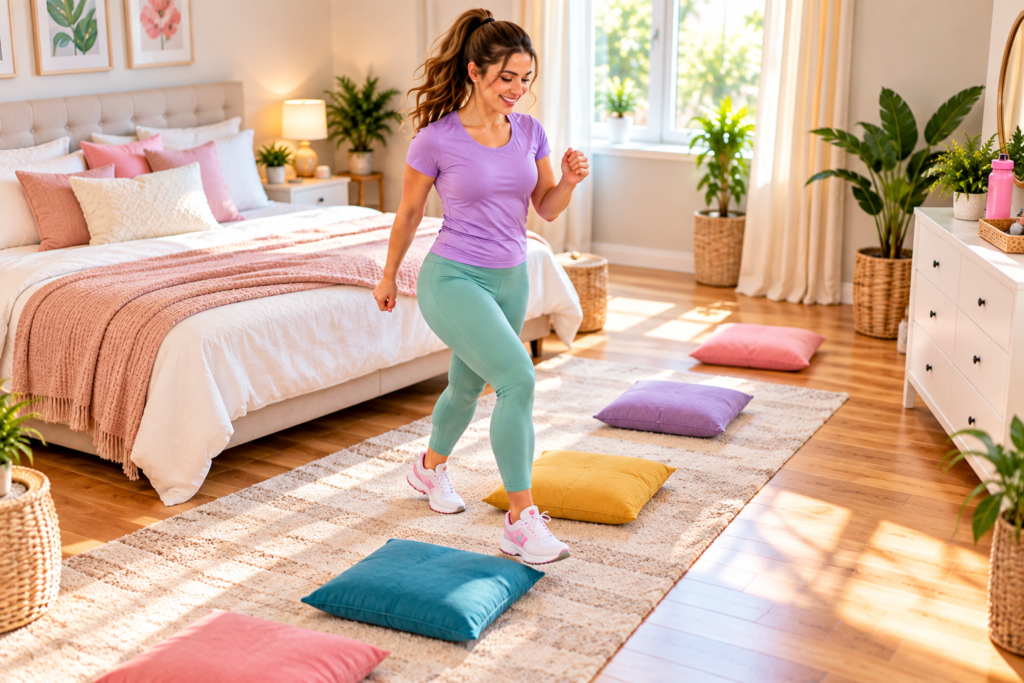
Image Description: Cozy bedroom with warm morning light, cream bedding, pale wood floor, soft neutral rug, several colorful flat floor cushions placed safely along an open route, and woman in a lavender workout top with mint leggings stepping between markers. Slight overhead perspective, realistic Pinterest fitness photography.
BEFORE: A small room can make regular walking feel cramped, especially when there is no obvious route around the furniture. Random turns may also interrupt your rhythm.
AFTER: Create a short route using flat, stable visual markers placed well apart on a clear floor. Step from marker to marker, then reverse direction and repeat without rushing.
The markers give your feet a simple destination while keeping the route compact. Use only objects that stay firmly in place and never step directly onto soft pillows that could shift beneath you. For extra variety, change the spacing slightly between rounds while keeping every step controlled and comfortable.
Dance Walk Steps
Image Description: Cheerful living room with bright natural daylight, warm wood flooring, cream walls, colorful cushions, compact speaker, and woman wearing a coral workout top with turquoise leggings performing rhythmic walking steps. Dynamic three-quarter camera angle, realistic lifestyle photography, lively but uncluttered Pinterest fitness aesthetic.
- Start walking: March or walk in place to establish a comfortable rhythm.
- Add a side step: Take two small steps right, then return left.
- Use your arms: Add relaxed arm swings or gentle forward reaches.
- Change direction: Alternate forward, backward, and side movements when space allows.
- Finish slowly: Reduce the pace for one to two minutes before stopping.
Dance-inspired walking adds variety without requiring formal choreography. Keep every movement low impact and stay within your available space. Choose music with a steady beat rather than a very fast tempo at first. The goal is to keep moving comfortably while enjoying the rhythm, making this especially useful when repetitive walking starts to feel dull.
Doorway March
Image Description: Bright home hallway with soft natural window light, warm beige walls, pale wood flooring, white doorway, small indoor plant, and woman wearing a mint green athletic top with coral leggings marching in place near the doorway. Eye-level three-quarter camera angle, realistic Pinterest fitness photography.
DO:
- Choose a doorway with plenty of open floor around it.
- March with small, controlled knee lifts.
- Keep your shoulders relaxed and posture upright.
- Use the doorway as a visual reminder for short movement breaks.
DON’T:
- Don’t hold the doorframe while marching unless balance support is necessary.
- Don’t block the doorway while other people are using it.
- Don’t march on slippery flooring.
- Don’t raise your knees higher than feels comfortable.
A doorway can become a simple visual cue to move for a few minutes. Rather than waiting for a long workout window, use short marching intervals whenever you pass through the area. Keep the route unobstructed, and choose another location if the doorway is busy or cramped.
Clock Face Steps
Image Description: Spacious light-filled living room with pale oak flooring, cream walls, subtle pastel accents, and woman wearing a blue athletic top with peach leggings stepping toward numbered floor markers arranged like a clock face. Slight overhead camera angle, realistic photography, clean Pinterest workout aesthetic.
Cost: Low | Time: 5 to 12 minutes
Skill Level: Beginner | Best For: Coordination
Equipment: Optional floor markers | Difficulty: Easy to moderate
Clock-style stepping gives your feet several directions to explore while keeping the pattern organized. Use imaginary positions if you prefer not to place markers on the floor. Step forward, diagonally, and sideways at a comfortable pace, then return to center. Keep each direction controlled and avoid quick pivots.
March And Punch
Image Description: Modern home workout room with warm natural sunlight, light wood flooring, cream walls, small mirror, water bottle, and woman wearing a yellow athletic top with purple leggings marching while performing gentle alternating punches. Front three-quarter camera angle, realistic lifestyle photography, crisp Pinterest fitness aesthetic.
Marching gets a lively upper-body variation when you add controlled punches. Keep your feet moving while extending one arm at a time toward the front. Stop each punch before fully locking your elbow, then return your hand smoothly. Maintain a relaxed neck and steady breathing throughout the movement.
Start with 20 seconds of alternating punches, followed by 40 seconds of ordinary marching. Repeat several times if the movement feels comfortable. I’ve found that combining simple lower- and upper-body patterns can make a short session feel more complete without needing equipment. Keep the punches controlled rather than trying to move as quickly as possible.
CONCLUSION
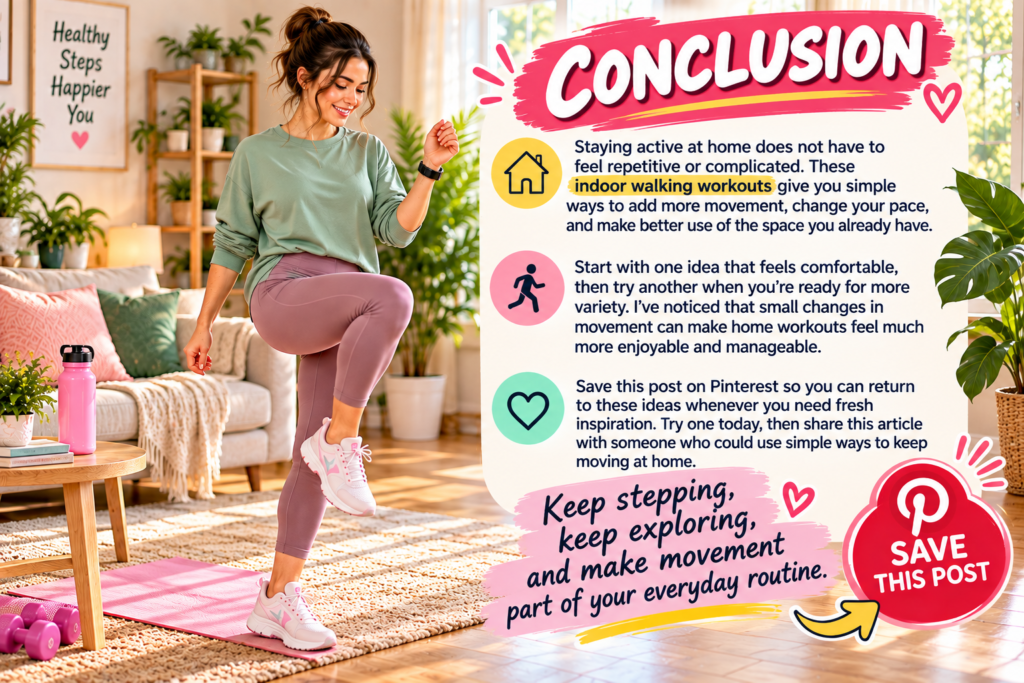
Staying active at home does not have to feel repetitive or complicated. These indoor walking workouts give you simple ways to add more movement, change your pace, and make better use of the space you already have.
Start with one idea that feels comfortable, then try another when you’re ready for more variety. I’ve noticed that small changes in movement can make home workouts feel much more enjoyable and manageable.
Save this post on Pinterest so you can return to these ideas whenever you need fresh inspiration. Try one today, then share this article with someone who could use simple ways to keep moving at home. Keep stepping, keep exploring, and make movement part of your everyday routine.